The seventh book set in Astreya’s world was published in July 2026. Here’s where to buy any book in the seven volume series !
Curious? You can read the first chapter right here, as I introduce a new rogue, Bastian
Chapter 1: In which Bastian prepares to seek his fortune
It was the twenty-fifth birthday of Sebastian Pierre Martin Crétien Gaspard de Coligny, sometimes called Bastian, though seldom to his face. It was also the day he officially took up the responsibilities and privileges of adulthood. Though he had the leading role in his birthday festivities, the event was all about The Family, as led by his Aunt Clarice and Uncle Arthur. It was their conviction that no other name was as fine, as wealthy, as old and revered as theirs, since they could trace their ancestry more than five centuries back to Gaspard de Coligny, martyr to his Huguenot faith in that old and faraway country that had long been forgotten by persons of lesser lineage. They expected Bastian to celebrate The Family and his coming of age by choosing a bride from one of the maidens they had selected from those they regarded as the best families of Cottontown. They were soon to be disappointed.
The high-ceiling room was crammed with people in their best attire, all come to witness Bastian’s accession into manhood, and more importantly, to witness the conjoining of two important families. The crowd pulsed and seethed. Swords and spurs menaced hoop skirts and crinolines. Candles dripped wax on linen tablecloths. Despite the room’s high ceiling and open windows, the temperature rose. Everyone was desperately uncomfortable, but nobody would admit it — at least not until the evening was over.
Six young women stood in line facing the purple velour and gold-leaf chairs in which sat Bastian’s aunt and uncle. He stood beside them, wearing tight blue formal trousers, a gold-trimmed bum-freezer jacket and ruffle-fronted white shirt. Auburn hair framed his aristocratic face, which was set in an aloof stare. The fair ones from whom he was to choose his bride ranged in age from a maiden so much too young that he was embarrassed that her parents had allowed her to compete so publicly for his hand and roving eye, all the way up to a woman so much too old for him that the words ‘well preserved’ came to his mind. The four in the middle he knew only distantly. They had all grown up within walking distance, but had been kept separate in their respective schoolrooms where their teachers performed their primary task as wardens of sexual repression for six days each week, the seventh being reserved for Sunday church.
Bastian’s domini, as that learned but louche ornament of faded gentility chose to be called, taught him heavily mythologized history, a smattering of practical mathematics, a simplified version of astronomy, and more practically, how to wear and use a dagger. His teaching method was to ridicule Bastian’s mistakes, pour scorn on his efforts, and belittle his achievements. Fortunately, the domini was exceedingly lazy, so after a few years, the two of them came to an unspoken agreement that since the domini had already taught enough, he should cease, giving Bastian time to do as he chose so long as he did not disturb his teacher’s lasting and eventually fatal relationship with the bottle. While his domini drank himself senseless, Bastian roamed the family library, reading about how life had been before the Dark Century which followed the Great Cataclysm. He read secret works of forbidden knowledge often disguised by fake covers or hidden in false-backed shelves. He revelled in forbidden accounts of days when cunning devices allowed men to exchange ideas and give commands over great distances and at lightning speed. He delighted in accounts of how long ago ships crossed oceans bearing untold riches, and he marvelled at accounts of when people flew above the clouds. All this reading made Bastian yearn for a day when such wonders were once again possible.
There was no one with whom Bastian could safely talk about what he had read. There were severe penalties for re-inventing the past, because everyone knew that any such knowledge would inevitably lead to disaster. Parents and teachers did all they could to maintain an optimum level of ignorance about life before The Great Catastrophe, which had definitively established that there are things mankind was not meant to know. Sermons, homilies, lectures and prayers, as well as severe penalties enforced by law, all ensured that the righteous few whose ancestors had survived the Catastrophe would remain pure throughout the present and depraved time until almighty justice smote the sinful world while the chosen few enjoyed their heavenly reward. To this end, priests taught a muscular, self-sufficient, and unquestioning faith, in which a man’s good right arm was the source of his prosperity, and the virtue of his wife was the measure of his social status.
Admonitions adorned the church Bastian attended every Sunday of his life. Carved over the door, on the ceiling, and around the windows were the maxims of a life well lived:
“God gives only what man earns,”
“Praiseworthy men protect faithful families,”
“Wise men shield women and children from falsehood,”
“Obedient women keep silence in this wicked world.”
The faith of Jean Calvin, as mutated by The Great Catastrophe, taught Bastian that he was one of the few who were were chosen to go straight to heaven, where they would praise the Almighty forever, grateful that they had not been extinguished with the great majority. At the age of sixteen, since he going to heaven anyway, Bastian decided to make himself as satisfied, content, and prosperous as possible.
Fortunately for Bastian, his decision was in harmony with what his aunt and uncle had planned for him. The process started with Bastian learning as much as he could from his uncle Arthur, a man with a formidable nose and a forbidding manner. Bastian shadowed his uncle at work, watching him exact obedience from underlings, compel industry from workers, and negotiate deals small and large, all of which he did stony-faced, even-voiced and inscrutable. At the close of each day, Arthur pointed his nose at his nephew, fixed him with a reptilian gaze, and had him recount all that he had seen and learned in merciless detail.
Thanks to his tutor, Bastian knew how to withstand scorn, and in time earned his uncle’s grudging approval. As he neared his 25th birthday, his uncle Arthur made clear that Bastian would inherit the family business. From that moment on, their evening discussions grew almost cordial. However, Arthur did not know that Bastian had no intention of waiting until his uncle passed on to his foreordained bliss.
For Bastian, apprenticeship ended the day he realized how Arthur acquired his impressive mansion, financed his aunt Clarise’s undisputed control of Cottontown’s society, and funded Bastian’s training as his heir. His route to wealth lay in keeping other people in debt. Arthur found men in need of money, lended them cash at a level of interest nicely calculated to relieve them of profit, thus guaranteeing that they had to borrow from him again.
Until the party to celebrate his manhood, Bastian’s life had been focussed exclusively on the male world of business and commerce. Apart from chaperoned meetings in formal drawing rooms, and sidelong glances at the daughters of the families who occupied the front pews for Sunday church, Bastian knew only what his aunt had told him about the five women from whom he was to pick a wife.
However, Bastian was not without sexual experience. Since his late teens he had known occasional nights of debauch in another world less than an hour’s walk up and over the southwestern ridge to Black Bay, where the exclusively White male members of the leading families of Cottontown indulged in anonymous, impersonal interactions with more or less willing Black women. At first led by his domini, then on his own, Bastian partook in these silently sanctioned exceptions from the chastity and sobriety professed by men of his social standing.
Bastian’s guardians, Arthur and Clarise de Coligny were determined to protect their family’s bloodlines from contamination by the lesser orders of humanity. Cloistered chastity for girls and discrete debauch for boys ensured that all were groomed like the puppies of champion hunting dogs so that they would be ready for advantageous marriages. Everyone at Bastian’s birthday party — except for the much-too-young girl — understood both the spoken and unspoken rules perfectly.
Bastian was planning to break them all.
The closest he came to being attracted by the young women paraded before him was the one who was far-too-old. Almost as tall as he, she had been gussied up a in dark velvety-green dress that began in a straight line across her collar-bones, and fell unimpeded all the way to the floor. The garment was designed to show off her smooth white shoulders, arms, and hands that had never done anything more demanding than needlework, while shrouding her every other part in mystery. Bastian bowed to the correct angle of deference. As he bent towards her cold fingers the words ‘painfully thin’ ran through his mind, and he understood that her compressed lips were those of a woman doing her best to hide within herself until her public humiliation would be over. He gave her a distant and respectful nod: the one he had perfected for mayors, ministers, and business competitors his uncle Arthur was about to fleece.
Moving on down the line, Bastian inclined his head over small gloved fingers that pulled him towards a deep cleavage between breasts barely restrained by plum-coloured satin. He recovered his hand and strode on to bend over bony knuckles belonging to a gangling young brunette in a dress so far out of style that it must have been her mother’s. He stepped two more paces to the right where his fingers were grabbed in both the sweaty hands of a plump, auburn-haired girl in a dress as pink as her rounded cheeks. His formal obligation completed by an air kiss above her knuckles, he pulled his hand from her damp grasp and contrived to dry his fingers unobtrusively on his best blue trousers before they were clutched by a young woman with a blonde, head-tossing, curly-whirly confection of hair that effectively doubled the size of her head. Fragrance of magnolias exuded from the tight, shiny, aubergine dress into which she had been crammed. Bastian bent over her hand, avoided her wide hazel eyes, nodded solemnly, and escaped her over-perfumed presence to make his way to the last of the line, where he manufactured his most polite and distant smile for the much-too-young girl with a big gap between her front teeth, hoping she was sufficiently excited at being allowed to be up past her bedtime that she would have no memory of him whatsoever.
Duty done, Bastian bowed from the waist at all six, then at the hovering mothers and aunts, at their respective husbands, and slightly but significantly less deeply toward the rest of Aunt Clarice’s invitees. Then as quickly as decorum would allow, he strode down the wine-red carpet between the families, friends and freeloaders, on past the maids, footmen, attendants, and hangers-on, through the big double doors and up the main stairs to his room, where custom dictated he should consider his verdict for a judiciously calculated quarter hour before re-appearing to announce which fair maiden would be his choice.
Aunt Clarice had informed him in advance that he was to choose the pungent purple one, the eldest daughter of old money from sugar with whom the family’s fortune in cotton would profitably merge. However, Bastian had no intention of obeying. Instead he had decided to disappear and make a fortune in the same way as Arthur had taken over so many smaller businesses. Then he would triumphantly return and blend his own and his family’s business.
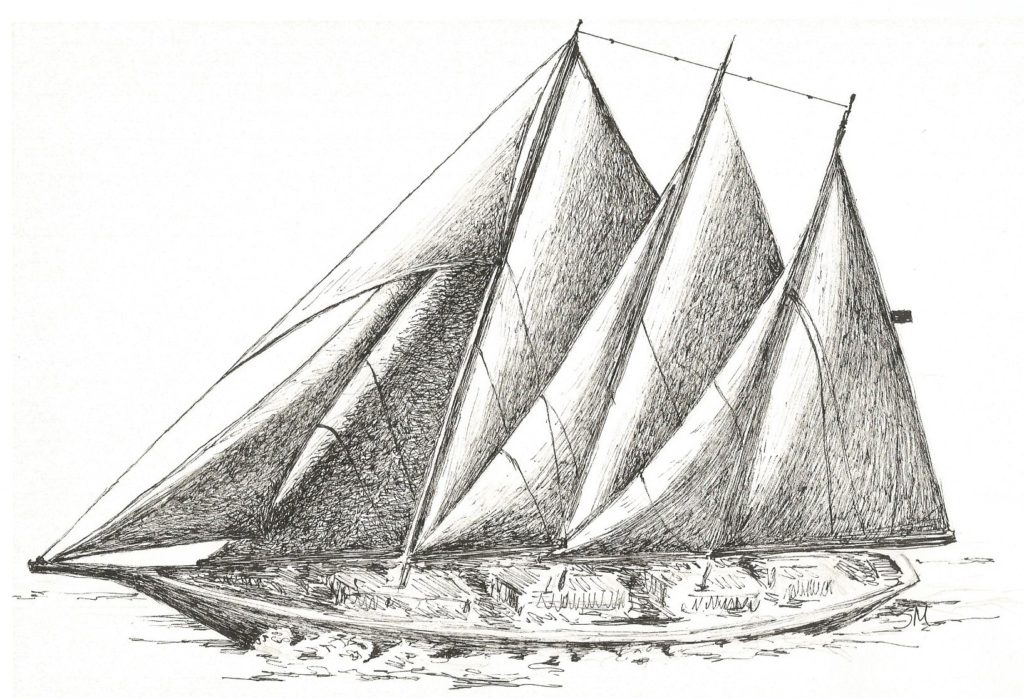
Bastian wore a wry smile as he ran up the stairs from the crowded ballroom to the small suite where he had lived ever since his parents failed to return from his father’s fatal attempt to catch a marlin from a rowboat. He prized up the loose floor board in the east alcove, took out a money pouch and a stag-horn sheath-knife, and hung them from his belt. Then he picked up the long-stemmed rose that he was supposed to present to the perfumed aubergine one before waltzing her into the formal engagement that would lead to wedding and bedding. He pinned the blood-red bloom to the head-board of his bed with the fancy little pearl-handled dagger that had ornamented his right thigh throughout the ceremony. Then he glanced at his reflection in the tall, mahogany-framed mirror, adjusted the ruffles of his shirt, curled his mouth into his most cynical smile, gave thanks that his nose was not as grotesque as his uncle’s, and then while still admiring his image, slung his longest and most anonymous cloak around his shoulders in a ripple of black shadows, and stole silently down the servant’s staircase, through the back door and out into the night. Invisible to the well-dressed people murmuring to each other within the lighted windows, he climbed over the garden wall, and walked down the darkened streets to the harbour where lay a three masted schooner awaiting his arrival and the turn of the tide.
As he walked through the darkened town, Bastian gleefully contemplated his own audacity. Instead of merely augmenting his family’s fortune, he would make his own. He savoured the plan had come to him on one of his moonlight adventures to Black Bay. He had been drinking in a tavern frequented by old sailors who, once primed with rum, told him tales of ships that sailed north of the line where the compass failed, south to the Sunny Isles, and eastward far out of sight of land — all of which would have been unbelievable to anyone who had not spent hours reading forbidden books.
In that one evening, Bastian’s expectations expanded, and his plans for the future were never again circumscribed by the tight and tidy world of the best families who lived in Cottontown. He had been aware of the great ships since childhood, and had marvelled at their size and the array of goods which they traded. The priest advised his congregation that the ships were vessels of evil, and his uncle Arthur warned him off the sailors from the north because they could not be caught in the spider’s web of debt in which Arthur managed his business. The two prohibitions merely made Bastian’s plans more devious and cunning.
Three months before his birthday, when two of the ships from the north were in harbour, Bastian had lurked in The Binnacle, the pub frequented by the skipper of the great ship Elusive whenever she visited Cottontown.
The tap room was unusually empty that Friday night, with a scant half dozen men drinking at the tables. Two men in seafarers’ blue jackets with bright brass buttons and black breeks sought out the darkest corner of the inner wall, where shoulder-high wooden panels screened them from a smaller booth next door. A single candle on the table between the two was little more than a yellowish glow to remind the server to refill their mugs without attention to their faces. From their seclusion they could observe the bar, the door, and the central common tables, which were dimly lit by lanterns hanging low enough to threaten the head any man over average height.
The two men spoke quietly, thinking that their voices were inaudible beyond the dark alcove. In a corner of the booth next to them a black cloak hung from beneath a shapeless hat. To a casual glance, the garments looked as if they had been abandoned by a forgetful, drunken customer; but under them Bastian sat very still, his ear pressed against a thin panel separating the booths. He had snuck in by the back way. A coin each to the cook, the pot boy, and the taverner, and he was hidden before the two captains came in the front door.
The brim of a borrowed hat on his nose, Bastian memorized words, names, and phrases. He knew what the two men looked like, because he had followed them at a distance as they came from their ships to the tavern.
One was tall, blonde, bearded, blue-eyed, with muscular shoulders and a bold, swaggering manner. He was in his late twenties, which was roughly half the age of the other, who was a head shorter and as nondescript as the other was distinctive. However, the older man spoke with the confidence of experience, to which his handsome friend gave grudging attention.
“I don’t like it, Trog,” said the undistinguished, shorter man.
“It’s just good business,” the good-looking one replied defensively.
Bastian’s attention redoubled.
“Yeah, but it ain’t fair. Not how ‘Streya set things up when he started the business.”
“I don’t cheat. Elusive does the long trips, the open-ocean voyages. All you do is cruise the coastline and call in at the smaller ports with cargo I bring to you, for which I’ve payed a fair price.”
“But you sell it to Damon and me for more.”
“Transport costs.”
A brief silence indicated that neither believed the excuse.
“Point is, Trog, that by pocketing the extra, you’re cheatin’ the fleet, cheatin’ us all.”
Under his hat, Bastian smiled. He had found an exploitable individual, well placed within a functioning organization that was not limited by a single commodity. A few weeks later, Bastian strode confidently towards the schooner Elusive, with whose captain he had secretly booked passage to the Sunny Isles.